195 Views
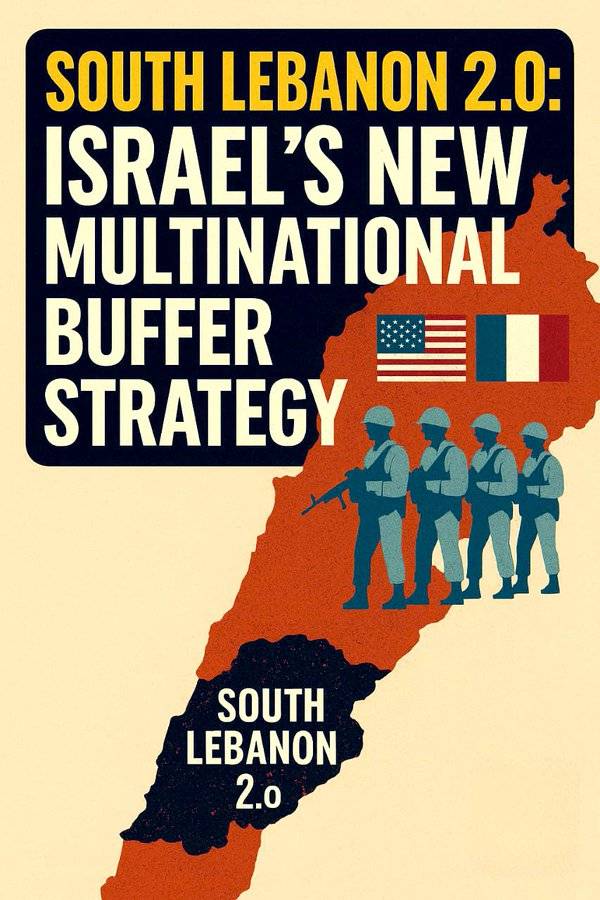
South Lebanon 2.0: Israel’s New Multinational Buffer Strategy
For decades, Israel’s strategic objective in south Lebanon has remained unchanged: to create a protective buffer, military, political, or proxy, between its northern settlements and the armed resistance across the border.
What has changed over time is the method.
Today, after months of escalating tension and diplomatic maneuvering, Israel appears to be promoting a new version of an old formula, one that echoes its occupation years but is packaged under an international banner.
The Historical Blueprint: How Israel Worked in the Past
During its occupation of south Lebanon from 1982 until 2000, Israel relied heavily on a carefully engineered structure that allowed it to maintain control without paying the full price of day-to-day confrontation.
That structure was the South Lebanon Army (SLA), a militia armed, funded, and directed by Israel.
The SLA’s mission was clear:
-Control the area between the Litani River and the occupied border, effectively administering it on Israel’s behalf.
-Serve as a buffer between Israeli soldiers and the Lebanese resistance.
-Absorb casualties and political costs, sparing Israel the domestic backlash associated with military losses.
In essence, Israel outsourced its most dangerous tasks to a Lebanese proxy. When the resistance dismantled this buffer in 2000, Israel’s occupation architecture collapsed with it.
Today, Israel is seeking a replacement, and it may have found an opening.
A Lebanese Statement That Opened a Door
When Lebanon’s president and prime minister declared recently that “Lebanon welcomes any country that wishes to keep its forces, or part of them, in the south to assist the Lebanese Army after the withdrawal is completed.”
This kind of phrasing widens the political space for new foreign forces to remain on Lebanese soil, at a moment when the international community is already frustrated by the limitations of the current UNIFIL mandate.
It inadvertently offers Israel a legal and political pretext to promote the deployment of more assertive international troops in south Lebanon, mainly American and French forces, operating with broader powers, sharper mandates, and far fewer constraints.
Such language does not merely invite “assistance”; it risks placing Lebanon on a trajectory where foreign militaries, not Lebanese institutions, shape security decisions in the country’s most sensitive region.
It exposes Lebanon to the very dangers it has spent decades trying to escape: internationalization, dependency, and the gradual erosion of sovereignty.
In effect, it opens the door to a new version of the SLA, only this time, not a Lebanese proxy force serving Israel’s interests, but an international one positioned on Lebanese soil with the mandate to act where the Lebanese state cannot.
Israel’s Goal: A New Multinational Force Under Chapter 7
What Israel now seeks is a multinational military force operating under Chapter 7, giving it the legal authority to use force inside Lebanese territory. Under this model, the new force would:
-Conduct raids and house searches in Lebanese towns.
-Enforce demilitarization by coercion.
-Create a de facto buffer zone separate from the Lebanese state.
-Engage directly with the resistance, shielding Israel from the first line of confrontation.
This gives Israel something incredibly valuable: political cover. Any clash with such troops would be framed not as a local fight with Israel’s enemies but as a confrontation with the states supplying those soldiers.
The presence of foreign troops in south Lebanon would erode sovereignty, internationalize the region, and place Lebanese civilians under the authority of forces whose agendas are shaped abroad rather than in Beirut.
Israel’s strategy is a recycled version of the old SLA model, this time multinational, absorbing risk and acting as a shield while leaving Lebanon vulnerable to foreign control unless it actively resists
Ebrahim majed

Comment
Post a comment for this article